


Gardening with Place: Creating a Nature-Friendly Garden in Kamloops
By Jay Akerley
(Facebook & Instagram: Jay Akerley | Web: www.jayakerley.com)
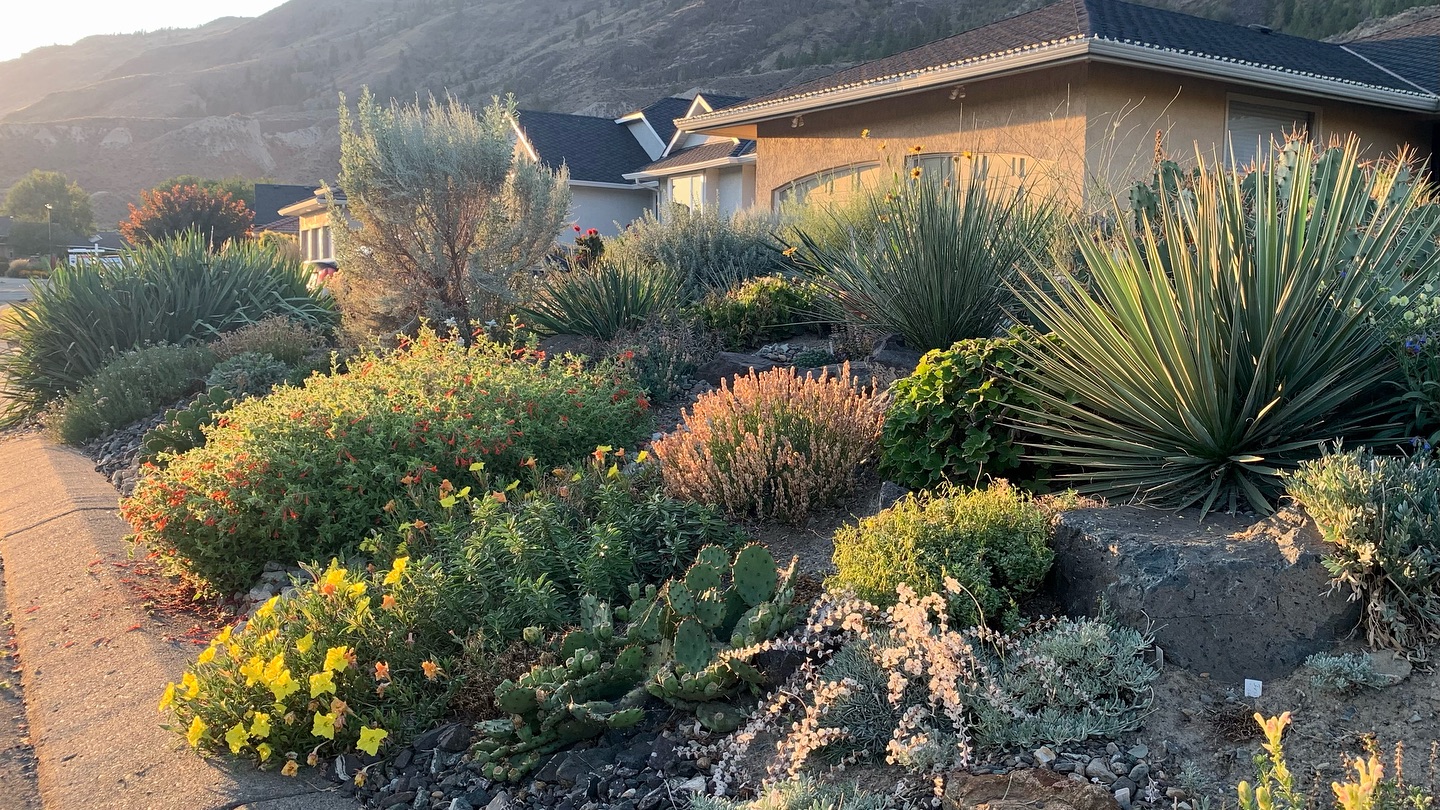
A nature-friendly garden does not have to look wild, untidy, or like a reconstruction of a particular natural ecosystem. It can be deliberately made and continually cared for while recognizing the conditions of its place and creating room for other forms of life. My front-yard garden just outside Kamloops has developed from that idea.
I have gardened in British Columbia for more than twenty-five years, from Vancouver at sea level to the Thompson Plateau and the subalpine environs of Sun Peaks. I trained at the Pacific Horticulture College, graduated in Geography from Simon Fraser University, and have been involved with the Alpine Garden Club of British Columbia and the North American Rock Garden Society.
Rock gardening has been a particularly important influence. Although often associated with tiny alpine plants and elaborate stonework, it is fundamentally about understanding relationships between plants, soil, drainage, exposure, and climate—lessons equally valuable in a nature-friendly Kamloops landscape.
My garden is not an intentionally designed show garden, and it is not an attempt to recreate a patch of sagebrush steppe. It is an evolving experiment shaped by the conditions of the South Thompson Valley: hot summers, low humidity, limited precipitation, occasional severe winter cold, poor rocky soils, wind, and intense sunlight.
Gardening in Kamloops requires a willingness to accept extremes. Summer temperatures can exceed 40°C, while my garden has fallen below –30°C twice in my four winters here. Long droughts may be interrupted by intense rainfall. Snow cover can be uneven, and exposed sites can dry even during winter.
Before I built the garden, I had to understand these conditions. I considered how snow accumulates, which areas would dry out first, how water might move during heavy rain, where prevailing winds would create exposure, and how differences in elevation could create useful microclimates. The garden’s berms, shallow swales, rocky pockets, open spaces, and varied exposures were deliberate responses to those conditions.
A slight change in elevation can make a surprising difference. A raised berm may provide excellent drainage for a plant that dislikes winter wet. A shallow depression may retain enough moisture to support a plant that would otherwise struggle. A boulder can provide shade on one side, reflected heat on another, and shelter from wind behind it.
Since construction, I have continued to observe, test, and adjust: which plants survive without special treatment, which seedlings establish, and where snow lingers or soil dries first? The garden is an ongoing experiment, but it was not built blindly.
Illustration 1: Berms and Swales Design
A nature-friendly garden begins with plants, but not simply with a list of plants labelled ‘native’ or ‘drought tolerant.’ The important question is whether a plant is suited to the specific combination of conditions in the garden.
A plant may be native to British Columbia but poorly adapted to a hot, exposed, low-fertility site. Another plant may originate elsewhere but thrive in similar ecological conditions. I use both native and non-native plants, but I choose them thoughtfully: plants from dry grasslands, steppes, deserts, mountain slopes, and other regions with comparable seasonal stresses.
I am also interested in plants that are rare or virtually absent from horticulture. Much of what I grow is unavailable at local garden centres. I grow nearly everything from seed, often obtained from seed exchanges or ethically collected in dryland habitats around the world. Growing from seed opens a much larger horticultural world, allowing me to grow unavailable species, observe variation, and discover individuals suited to my garden.
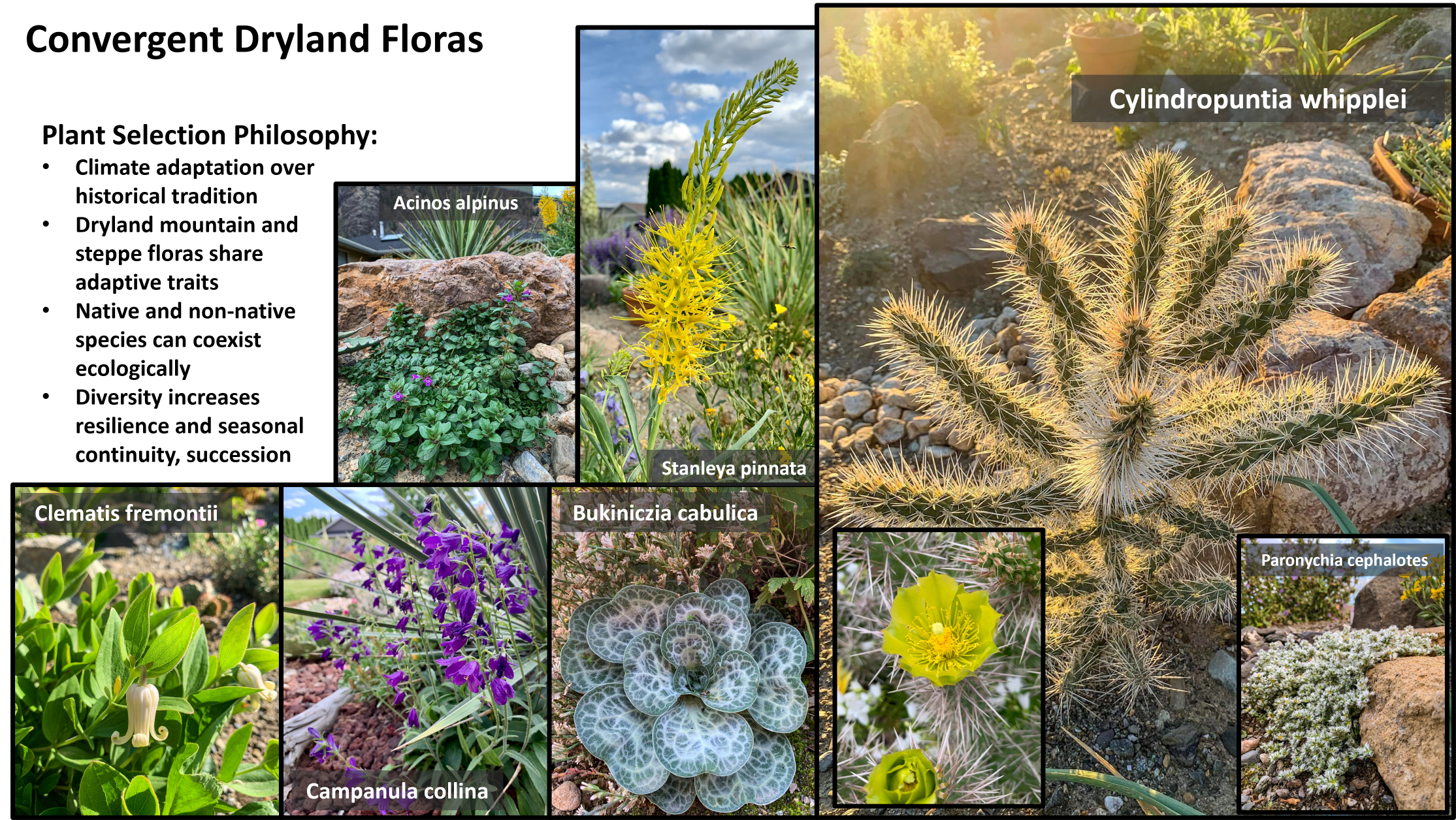
Illustration 2: Convergent Dryland Floras
Some of the familiar native plants I grow include big sagebrush (Artemisia tridentata), rubber rabbitbrush (Ericameria nauseosa), bluebunch wheatgrass (Pseudoroegneria spicata), Great Basin wildrye (Leymus cinereus), Idaho fescue (Festuca idahoensis), blanketflower (Gaillardia aristata), Lewis flax (Linum lewisii), sulphur-flowered buckwheat (Eriogonum umbellatum), prickly pear (Opuntia sp), and many species in the genus Penstemon.
Plant diversity is important, but I also think in terms of structural and dynamic planting. Established shrubs and grasses provide the garden’s framework, while shorter-lived plants, self-seeders, and seasonal openings keep it changing. Low flowers may offer colour but little winter structure or shelter. Shrubs and grasses provide cover, perches, seed, browse, and overwintering habitat. Flowering perennials support insects, while open areas provide warm ground and basking sites.
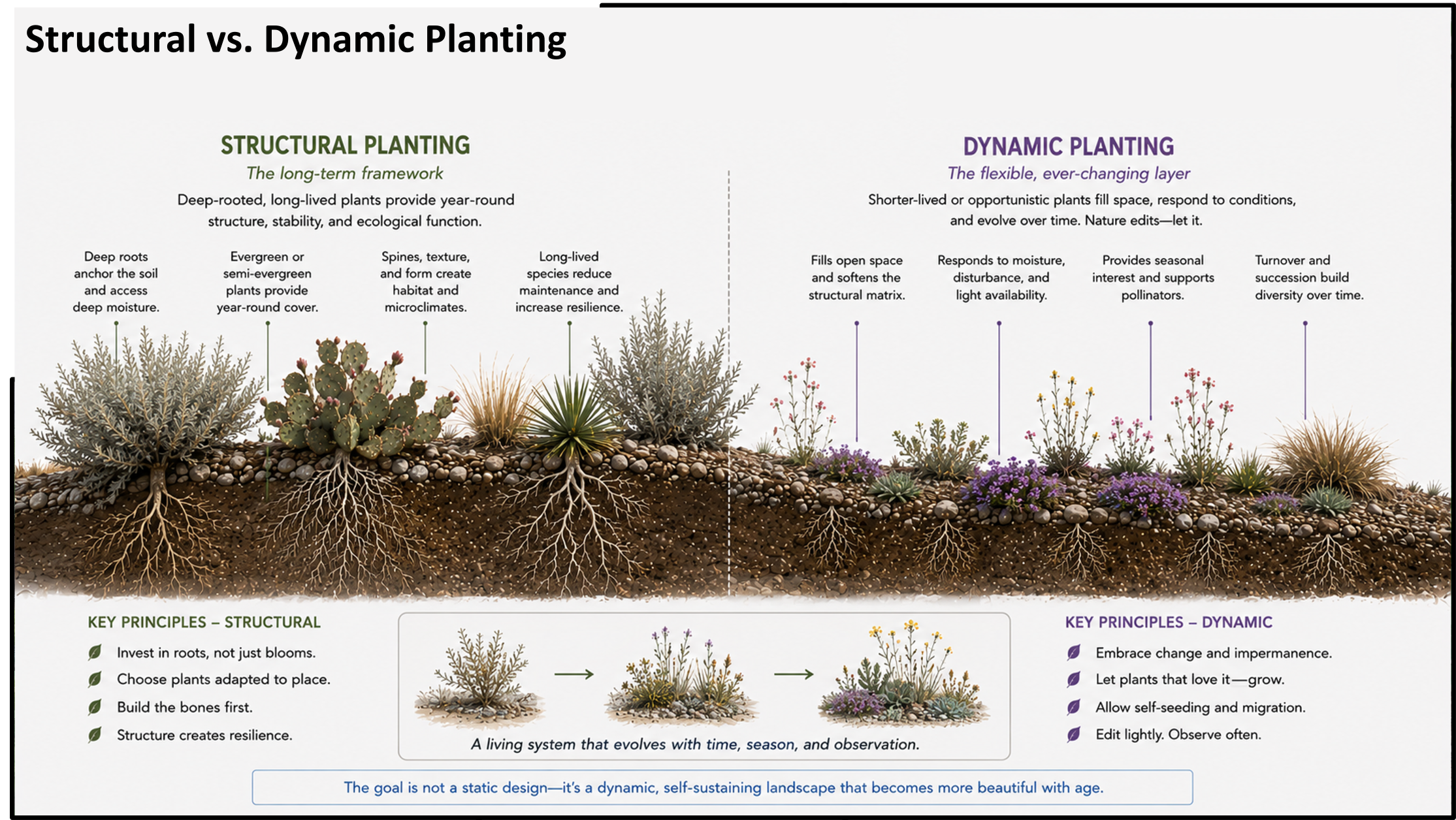
Illustration 3: Structural vs. Dynamic Planting
Established plants can also act as nurse plants, modifying conditions around them in ways that help others survive. A grass clump or shrub may shelter a seedling from wind, reduce evaporation, trap snow, moderate soil temperatures, or make it less visible to browsing animals.
Deer browsing is one of the realities of gardening in Kamloops. I do not treat it simply as an enemy to be defeated. Instead, I intentionally design for it.
Some plants are selected to tolerate or absorb browsing pressure. Tall grasses such as Leymus cinereus can provide substantial vegetation that deer may browse without destroying the garden’s structure. Sacrificial plants such as native Geranium viscosissimum and xeric willows such as Salix helvetica can also divert attention from vulnerable specimens.
No plant is absolutely deer-proof, but a garden can be made more resilient by distributing browsing pressure rather than concentrating it on a few prized specimens.
Many plants I grow are naturally unpalatable, having evolved where browsing by large herbivores was persistent. Aromatic shrubs, spiny plants, tough grasses, and bitter, resinous, hairy, or otherwise unappealing foliage can be valuable in a garden shared with deer.
Many gardeners have been taught that soil should always be covered with mulch or living plants. There are good reasons to avoid erosion, especially on exposed sites. But bare ground should not automatically be considered damaged or lifeless. In dry ecosystems, open soil is natural.
Small areas of open mineral soil can provide nesting sites for native bees, warm quickly in spring; they can also support other insects, and allow plants to reproduce from seed.
In my garden, bare soil is not a sign of neglect. It is a deliberate design element that mimics our natural bunchgrass environment. The spaces between plants allow for movement, seedling recruitment, observation, and maintenance. They also prevent the garden from becoming an undifferentiated mass of vegetation.
This does not mean every garden must be stripped of mulch. The right approach depends on slope, soil type, rainfall, and erosion risk. I use jagged stone mulch on a few steep slopes for erosion control and foot access. In a dry, well-drained garden, open ground can be practical and ecologically useful.
A nature-friendly garden still requires care. The difference is that maintenance is not necessarily about keeping the garden frozen in its original condition.
I often think of maintenance as editing. Seedlings may appear in unexpected places. Some are welcome; others are not. A plant may become too dominant, flop across a path, or shade a neighbour. A perennial may die, leaving a gap for something else. I remove, thin, transplant, or simply allow change.
This form of gardening requires observation rather than strict control. The garden is not abandoned, but neither is every change a failure.
Open soil also makes maintenance easier. Space between plants allows me to use a stirrup hoe while weeds are small. Paths and steppingstones provide access without compacting planting areas, and careful spacing makes it possible to work around established plants.
I also leave some vegetation standing through winter. I value a visually appealing garden in all seasons but avoid cutting back every perennial or removing every fallen leaf in autumn. Hollow stems, seedheads, leaf litter, and other plant debris provide shelter and overwintering sites for insects, including native bees. I cut back selectively in spring rather than treating a completely tidy winter garden as the goal.
The goal is not a garden without work. It is a garden where the work is minimized and appropriate to the conditions.
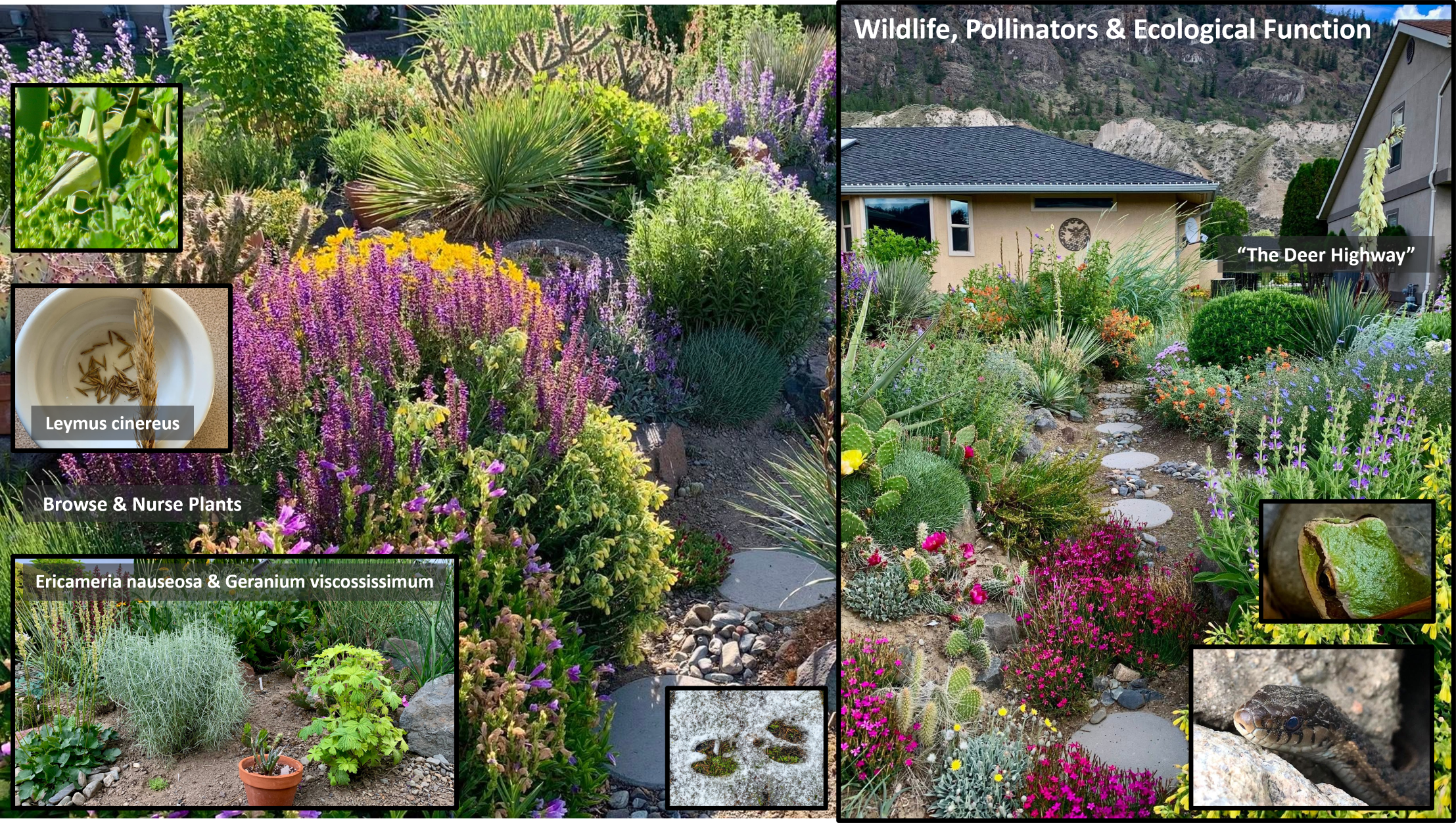
Illustration 4: Wildlife, Pollinators & Ecological Function
I only hand-water newly planted additions, using a small watering can to help seedlings establish. Other than that, the garden has not been watered in two years—ever. The plants survive entirely on natural precipitation.
That makes this garden effectively invulnerable to watering restrictions—which Kamloops is experiencing as I write this.
My garden features wild species selected for genuine survival in this climate. Note that many nursery cultivars are selected and bred for flower colour, form, size, or extended blooming—not necessarily maximum drought tolerance—and may require more supplemental water than their wild counterparts.
Gardeners do not need to reproduce my zero-water experiment. If they choose well-adapted cultivars and plant them in ordinary poor or spent garden soil, their gardens should still survive with minimal supplemental water once established.
I often post plant photos on social media. Take note of the genera I use. You may not be able to buy Penstemon cardwellii at a nursery, for example, but many Penstemon cultivars may offer similar colour, hardiness, and drought tolerance.
The soil in my garden is poor, rocky, and relatively low in fertility because I designed it that way for unusual, specialized species. Similar conditions could have been created using naturally rocky native soil or clean fill if you can find it.
As a rule, dryland plants do not require rich soil. Excess fertility can produce soft, floppy growth and increase water demand. Not every garden needs imported soil, large quantities of compost, decorative gravel, or elaborate irrigation.
Flowers provide nectar and pollen. Grasses and shrubs provide cover and seed. Bare soil supports insects, while small depressions can retain moisture after rain. Late-flowering species and a well-timed ‘Chelsea Chop’ can extend seasonal colour.
My garden is visited by bees, butterflies, birds, deer, and other animals. Not every interaction is convenient. Deer browse plants. Insects damage leaves. Seedlings appear where I did not put them. But a garden intended to support life cannot be designed only around human convenience.
That does not mean accepting every form of damage. Protection, plant selection, and editing are legitimate tools. Wildlife is not an accidental intrusion; it is part of the living system the garden participates in.
The most important lesson this garden has taught me is that resilience is not a finished appearance. It is an ongoing relationship between a place and the organisms living there.
Some experiments succeed. Others fail. A plant may disappear after several years, while an unexpected species becomes a dependable self-seeder. Severe weather may reveal weaknesses that were not apparent before.
It continues to change as I learn more about the site, as the climate changes, and as plants and wildlife respond in unexpected ways. That uncertainty is an invitation to pay closer attention.
For gardeners in Kamloops, creating a nature-friendly yard does not require copying my garden. It may mean replacing lawn with plants suited to local conditions, leaving leaves in place, reducing or “shutting off” unnecessary irrigation, planting a shrub for birds, selecting deer-tolerant plants, or allowing open ground to remain open.
It may mean asking different questions:
- What does this place already tell me?
- Which plants can thrive here without constant intervention, and where can I make room for wildlife?
- How can I make browsing pressure part of the design rather than an endless battle?
- How can the garden become less dependent on imported inputs, and how can I work with Kamloops’ challenges rather than trying to overcome them?
For me, that is the essence of gardening with place: respecting inherited conditions, exploring a wider world of plants, growing from seed if possible, accepting uncertainty, and creating a garden useful to the wider community of life.
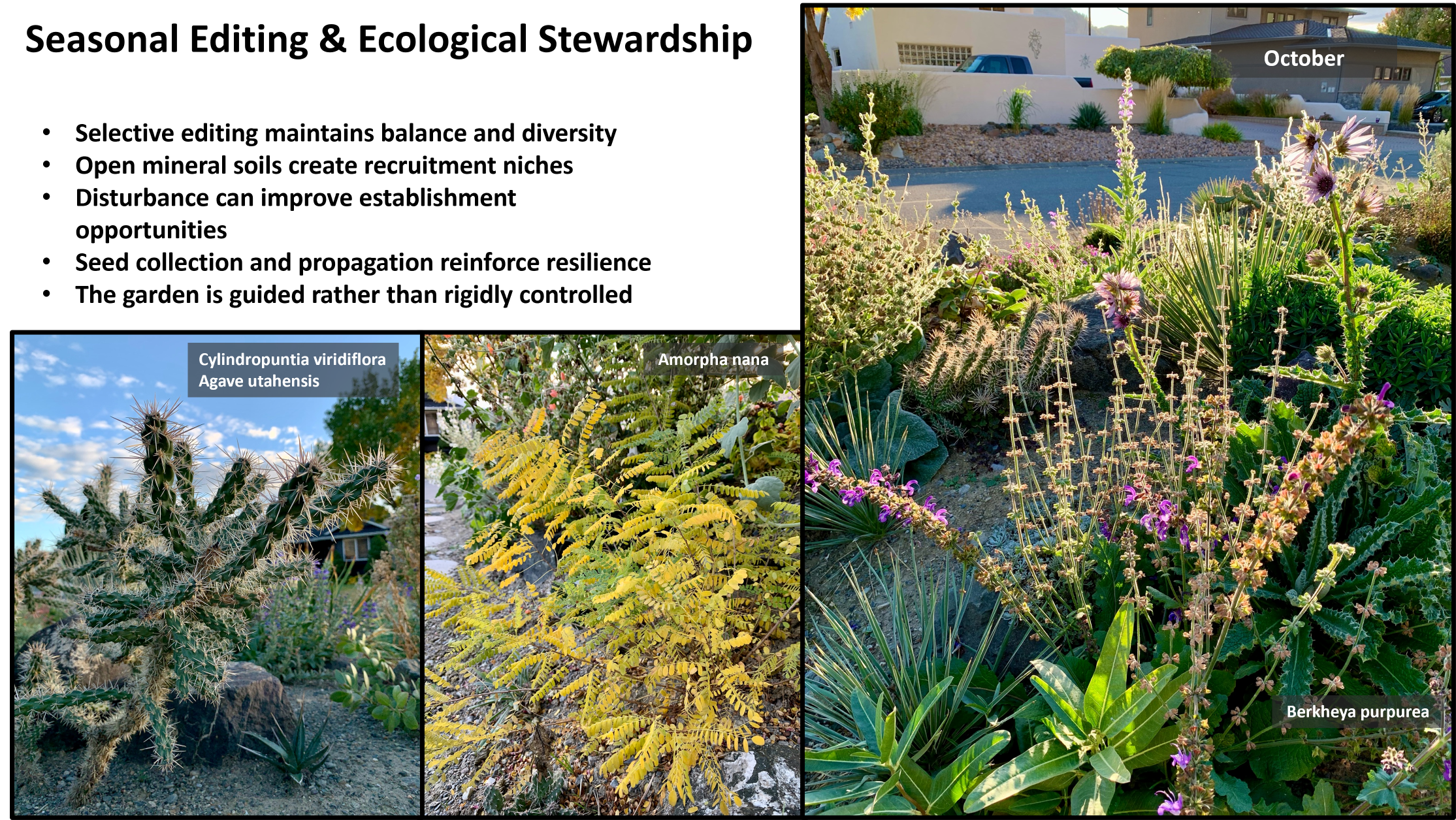
Illustration 5: Seasonal Editing and Ecological Stewardship